What UK, Irish, European, Canadian, Australian and New Zealand physiotherapists need to know before moving into Gulf private hospitals, clinics and UHNW home-based rehabilitation roles
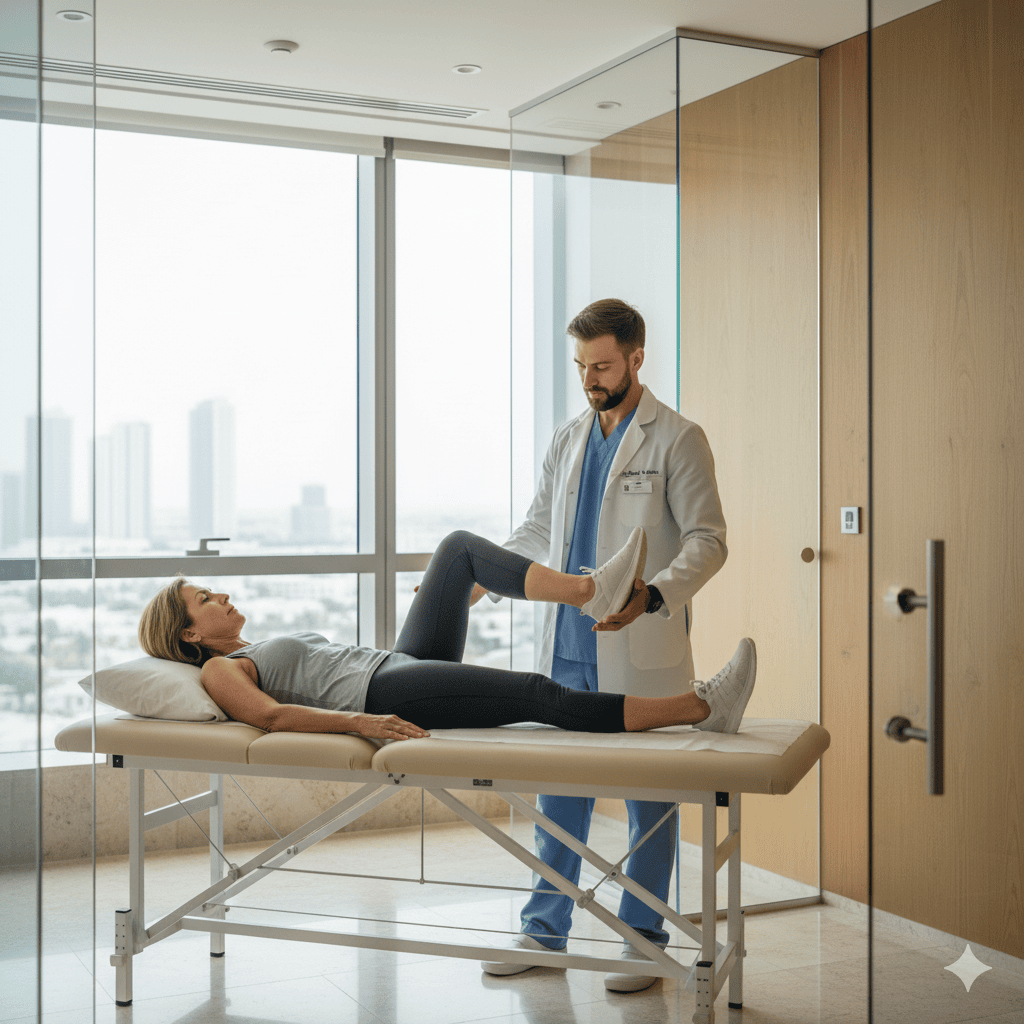
If you are a Western-trained physiotherapist working in the UK, Ireland, Europe, Canada, Australia or New Zealand, you have probably seen a steady rise in adverts for “physio jobs in Dubai” or “Gulf private rehabilitation roles”. The question is not whether the skyline looks impressive. It is what your daily practice will actually feel like in a private hospital, specialist clinic or UHNW residence in Dubai, Abu Dhabi, Riyadh or Doha.
The first difference is the setting. In the Gulf, physiotherapy frequently spans three environments: hospital-based rehabilitation, high-end outpatient clinics and home-based or concierge services for UHNW families. You may find yourself moving from a post-op knee in a private hospital, to a complex neuro case in clinic, to a discreet home visit in a villa or penthouse. The variety can be professionally rich—if the system behind it is well organised.
Clinically, you will recognise much of the caseload: orthopaedics, sports injuries, spinal pain, neurorehabilitation, post-ICU deconditioning and chronic disease management. What changes is the expectation around access and service. Patients and families are paying for rapid response, flexible scheduling and a high degree of personal attention. In UHNW and royal settings, sessions may be arranged around travel plans, security constraints and family routines. Clear boundaries and structured planning become essential.
Licensing is the next major shift. You will register under DHA (Dubai), DOH (Abu Dhabi), SCFHS (Saudi Arabia) or QCHP (Qatar), often with primary source verification and detailed credential checks. Titles, scope and even familiar techniques may be framed differently. When an employer is honest about timelines, documentation and typical exam or verification steps, licensing is demanding but manageable. When they promise it will be “quick and easy”, you should pause and ask more questions.
Team structure also matters. Some Gulf private hospitals and clinics have well-developed multidisciplinary teams: physiotherapists, doctors, nurses and allied health working to clear care pathways. Others operate more like commercial centres with thin clinical leadership and constant turnover. As a Western-trained physiotherapist, you will feel the difference in handover quality, case conferences, documentation standards and how incidents or near-misses are handled.
If you step into UHNW or royal household work, the dynamics change again. You may be the only physiotherapist—or part of a very small clinical team—operating in highly private environments: villas, compounds, yachts or private gym facilities. The key questions are simple: Who is the supervising consultant? How are goals set and reviewed? What happens in an emergency? What are the real expectations around availability, travel and discretion? Without clear answers, prestige roles can quickly become unsustainable.
Compensation is usually framed around tax-free salary, housing support and occasional travel home. It is essential to translate the package into real life: What kind of apartment can you afford in Dubai or Abu Dhabi? How far will it be from work? How often can you realistically travel home? Are CPD and professional development supported, or expected to come from your own budget and time? A coherent, transparent package in a well-run team is more valuable than a higher headline salary in a chaotic setting.
Culture and leadership will shape your long-term experience more than any individual patient. In some organisations, Western-trained physiotherapists are treated as genuine clinical partners, trusted to design and adjust programmes within agreed pathways. In others, they are treated as interchangeable technicians. Look for visible clinical leadership, stable colleagues who have stayed multiple years, and evidence that management listens when clinicians raise concerns.
Medical Staff Talent sits exactly at this intersection. We focus on permanent roles for Western-trained Physiotherapists—alongside Doctors and Nurses—in private hospitals, private clinics, royal households and UHNW families across Dubai, Abu Dhabi, Riyadh and Doha. Our role is not just to forward CVs. It is to map what the environment really looks like: caseload, governance, leadership, rota patterns, travel expectations and links between home-based rehab and hospital teams.
Because we understand both Western rehab culture and Gulf private realities, we can help you distinguish between roles that are glossy but fragile, and roles where you can practise serious physiotherapy with structure, support and room to grow. When those elements align, the Gulf can offer a unique chapter: complex cases, international exposure, modern facilities and the financial upside of tax-free work—without sacrificing your standards.
If you are considering a physiotherapist position in Dubai, Abu Dhabi, Riyadh or Doha, the central question is this: “Will I be able to deliver evidence-based, respectful rehabilitation in a system that supports me, and build a life that makes sense outside work?” When the answer is a confident yes, it is time to look closer. When it is not clear, you are right to keep asking.