What Western-trained clinicians should expect when private homes become clinical environments in Dubai, Abu Dhabi, Riyadh and Doha
From the outside, royal household and UHNWI roles in the Gulf are often described in soft focus: villas in Dubai and Abu Dhabi, palaces in Riyadh, waterfront residences in Doha, yachts moving quietly between marinas. For Western-trained doctors, nurses and physiotherapists, the reality is sharper. These are not lifestyle posts; they are clinical roles delivered in non-traditional environments. If the work is not designed as serious healthcare, it quickly becomes unsafe for patients—and unsustainable for the clinicians involved.
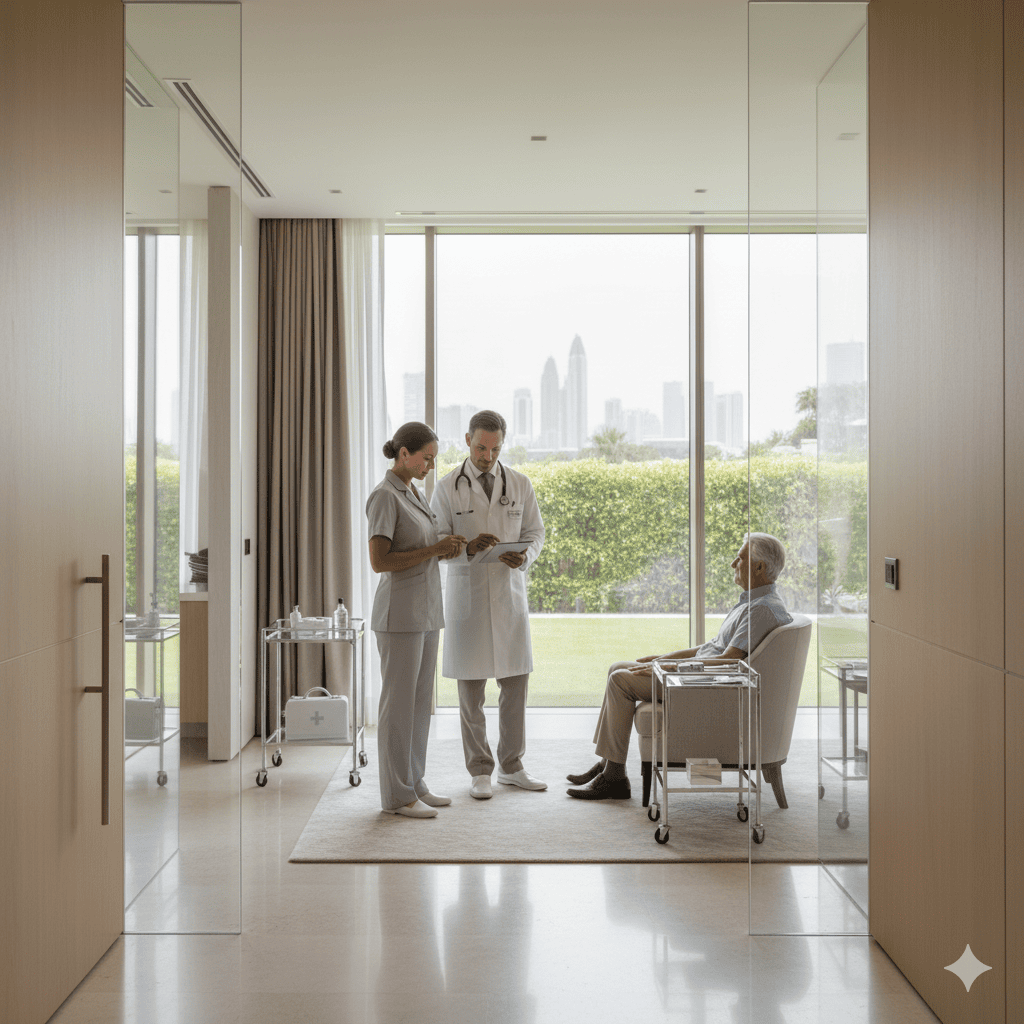
The first shift is simple to state but hard to implement: the home becomes a clinical setting. A royal villa with a dedicated medical suite in Abu Dhabi, or a Riyadh palace with a fully equipped treatment room, still lacks the redundancy of a private hospital. Oxygen, suction, medications and equipment may be present, but imaging, lab and rapid specialist support sit at a distance. Western-trained clinicians must constantly ask, “What can safely be done here, and what must move early to a hospital in Dubai, Abu Dhabi, Riyadh or Doha?”
This is where architecture matters more than decoration. Safe royal household and UHNWI care in the Gulf relies on explicit written pathways into named private hospitals and clinics: admission privileges, known consultants, clear escalation thresholds and pre-agreed ambulance or transfer arrangements. A Western-trained nurse in a palace in Doha, or a private doctor on a yacht off Dubai, needs to know exactly when to call, whom to call and what the receiving team expects to hear. Without that structure, each deterioration becomes a personal crisis, not a system event.
Scope of practice must be defined, not assumed. Western-trained nurses hired as “private nurses” can quietly accumulate non-clinical tasks—logistics, family support, informal childcare—until clinical focus is diluted. Western-trained physiotherapists invited to support “fitness and rehab” can be pushed towards coaching, entertainment or non-indicated treatments. Western-trained doctors may be seen as general problem-solvers for the wider family and entourage. Sustainable roles draw a clear line: clinical responsibilities, clinical decision-making and clinical documentation on one side; everything else handled by the household’s non-medical staff.
Documentation and privacy are equally important. UHNW families in the Gulf value discretion, but discretion does not mean the absence of records. Western-trained clinicians must document assessments, interventions and escalation decisions in a way that respects local privacy expectations while still meeting licensing and malpractice requirements. DHA, DOH, SCFHS and QCHP will judge your practice based on records, not memories. A calm, secure documentation system—linked to partner private hospitals where appropriate—is a non-negotiable part of royal household care.
Yacht medicine adds further complexity. A physiotherapist or nurse on a yacht moving between Abu Dhabi, Dubai and Doha is working in a constrained environment with shifting jurisdictions. Seasickness, falls, cardiac events and post-operative complications all look different at sea. Serious Gulf yacht setups have predefined diversion ports, named private hospitals onshore, robust medication policies and clear lines to telemedicine support. Western-trained clinicians should treat any role without that infrastructure as a red flag, no matter how attractive the surroundings look.
Rota design is often the hidden fault line. Many Western-trained clinicians accept royal household roles believing they will work “full-time but flexible” hours. In practice, they discover 24/7 expectations with minimal backup. Night calls, travel at short notice and constant low-level availability slowly erode judgement and wellbeing. Roles that last for years rather than months are structured differently: defined shifts, secondary staff for handover, protected leave and clear rules about when the clinician is genuinely off duty—even if they remain on the property.
Team stability in UHNWI settings depends on this structure. Families rarely intend to burn through Western-trained clinicians, but if the role is built around permanent heroics, that is what happens. Trusted royal household arrangements in Dubai, Abu Dhabi, Riyadh and Doha tend to have one thing in common: they treat the clinical team as a unit, not a single person. Western-trained doctors, nurses and physiotherapists share responsibility, cross-cover and debrief regularly, with clear links back into private hospitals for governance and learning.
From the patient and family side, serious design creates something invaluable: quiet confidence. When escalation from villa to private hospital is rehearsed rather than improvised, when Western-trained clinicians explain boundaries calmly, when care plans match what DHA, DOH, SCFHS or QCHP would recognise as good practice, UHNWI families relax. They may still request comforts and speed, but they stop expecting miracles in environments that cannot safely deliver them. That shift protects everyone.
This is precisely where Medical Staff Talent chooses to work. We specialise in recruiting Western-trained Doctors, Nurses and Physiotherapists for private hospitals, private clinics, medical concierge teams, royal households and UHNW families across Dubai, Abu Dhabi, Riyadh and Doha. For royal household roles, we look far beyond job titles and villas. We ask which private hospitals sit behind the home, how escalation is written, how rotas are structured, how malpractice cover works, and how Western-trained clinicians will be supervised and supported over time. We connect families and providers who want serious, stable arrangements with Western-trained teams who can hold that responsibility.
For clinicians, the key question is simple: if you removed the palace, the yacht and the travel from this role, would the underlying clinical architecture still feel robust and ethical? If the answer is yes, you may be looking at a rare, sustainable UHNWI role that respects your training. If the answer is no, you are being asked to carry risk on personal reputation alone. For royal households and UHNW families, the mirror question is whether they want long-term, hospital-level care at home—or a succession of short-lived “private nurses” and “family doctors” who leave once the reality becomes clear.
Royal household nursing and UHNWI medicine in the Gulf can be some of the most meaningful work a Western-trained clinician will ever do: long-term relationships, deep knowledge of one family’s health history, and the chance to quietly prevent crises rather than simply reacting to them. But this only holds if the work is designed with the same seriousness as any ICU or specialist clinic. At Medical Staff Talent, we do not romanticise villas and yachts. We help build stable, trusted medical teams around royal households and UHNWI families in Dubai, Abu Dhabi, Riyadh and Doha—teams whose structures are strong enough to protect patients, licences and clinicians for the long term.