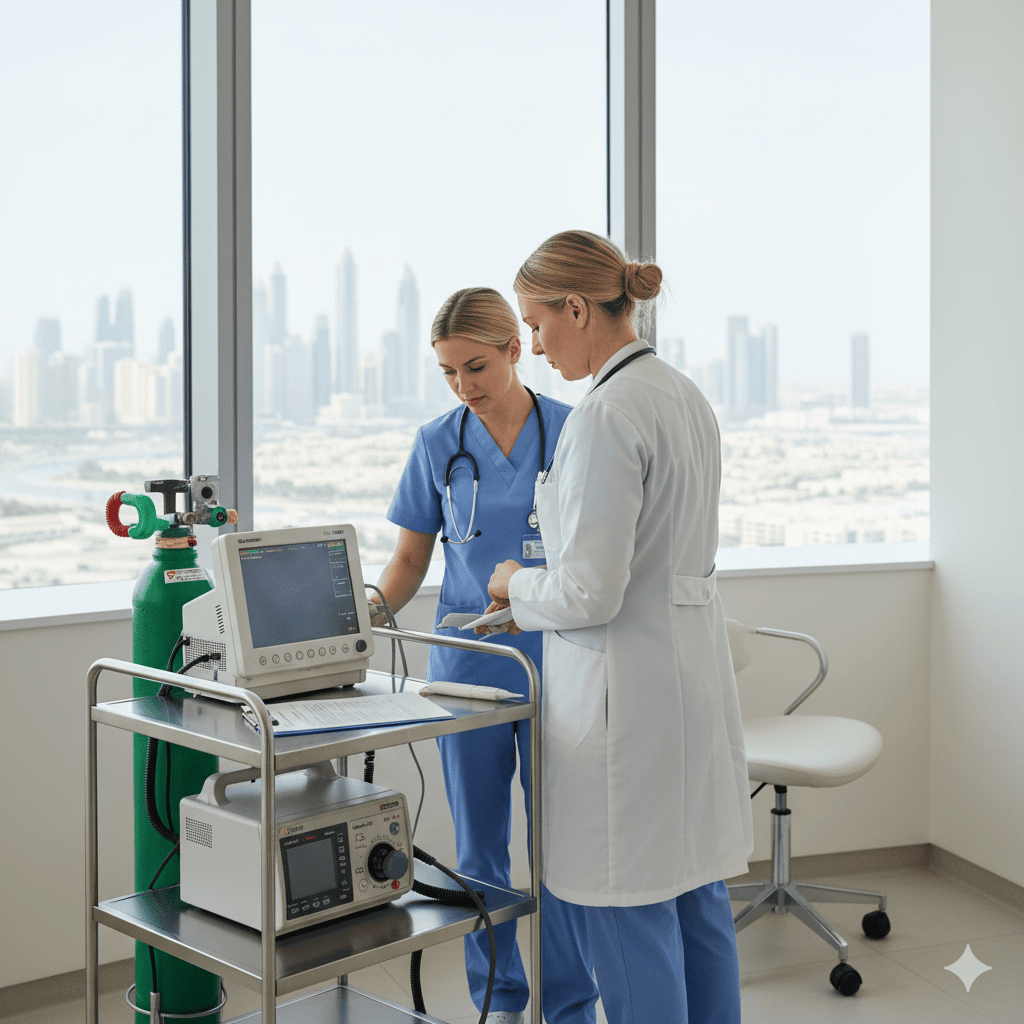
Why sedation governance matters in private clinics
Sedation touches airway, haemodynamics and memory. In private settings with tight schedules and VIP expectations, safety depends on three aligned pillars: licence + insurance (settings listed) + privileges. Without them, scope narrows or starts stall.
Gatekeepers (must be true before the first case)
Privileges: sedation listed (minimal/moderate/deep) with named proctors and sign-off path.
Insurance: policy in your name; clinic setting named (domiciliary only if explicitly covered).
Competencies: BLS for all; ACLS for doctors and any nurse assisting sedation; device IFU training (monitor/defib/pump).
Environment: room size adequate; suction, oxygen, bag-mask, capnography, defib, emergency cart with weight-based drugs.
Rota: second trained clinician available; post-sedation recovery nurse identified.
Team roles (simple, repeatable)
Sedationist (doctor) — drug choice, airway plan, stop/convert decisions.
Procedure lead — performs the procedure; cannot be the sole sedationist.
Monitoring nurse — eyes on vitals only; no tasks that distract from monitoring.
Runner — brings kit, calls for help, documents times.
Pre-procedure checks (copy/paste)
Drug safety (non-negotiables)
High-risk meds (opioids, benzodiazepines, propofol, ketamine) use independent double-check (IDC) for drug, dose, patient.
Titrate to effect; avoid stacking sedatives without time to observe peak effect.
Continuous capnography if beyond minimal sedation or any opioid/propofol is used.
Reversal agents drawn up, doses pre-calculated, expiry checked.
Monitoring bundle
Baseline: HR, BP, RR, SpO₂, ETCO₂ (capnography), consciousness score.
During: record q2–3 min; alarms on and audible.
Airway plan visible (jaw thrust → OPA/NPA → BVM → call for help).
Fluids, positioning, and warming as needed.
Recovery & discharge (make it boring)
Supervised recovery with continuous SpO₂ and regular BP until return to baseline.
Use Modified Aldrete or local equivalent; discharge only when scores meet threshold, pain controlled, and escort present if required.
Provide written aftercare with red-flag thresholds (bleeding, fever, pain, confusion, vomiting) and a 24/7 contact route.
Documentation that protects you
Time-stamped record of brief, drugs (dose/time/route), vitals, interventions, response.
Event note with SBAR and numbers (e.g., ETCO₂ rise to 55 → jaw thrust + O₂; SpO₂ 96% within 20 s).
Lot numbers for reversal agents and any consumables per local policy.
Emergencies: calm choreography
Call for help early; assign roles; start BLS/ACLS as indicated.
If transfer needed: named receiving hospital, route and ETA; send printed vitals strip and drug chart.
Domiciliary/UHNWI requests
Sedation outside the clinic (home/hotel/yacht) requires explicit insurance rider + privileges + equipment and a transfer plan. If any pillar is missing, decline or move to clinic.
Micro-audits (10 minutes, weekly)
Capnography used for all moderate/deep cases.
IDC documented for every high-risk med.
Reversal agents in date; doses pre-calculated.
Recovery notes include Aldrete and discharge escort.
One learning point captured; change adopted within 14 days.