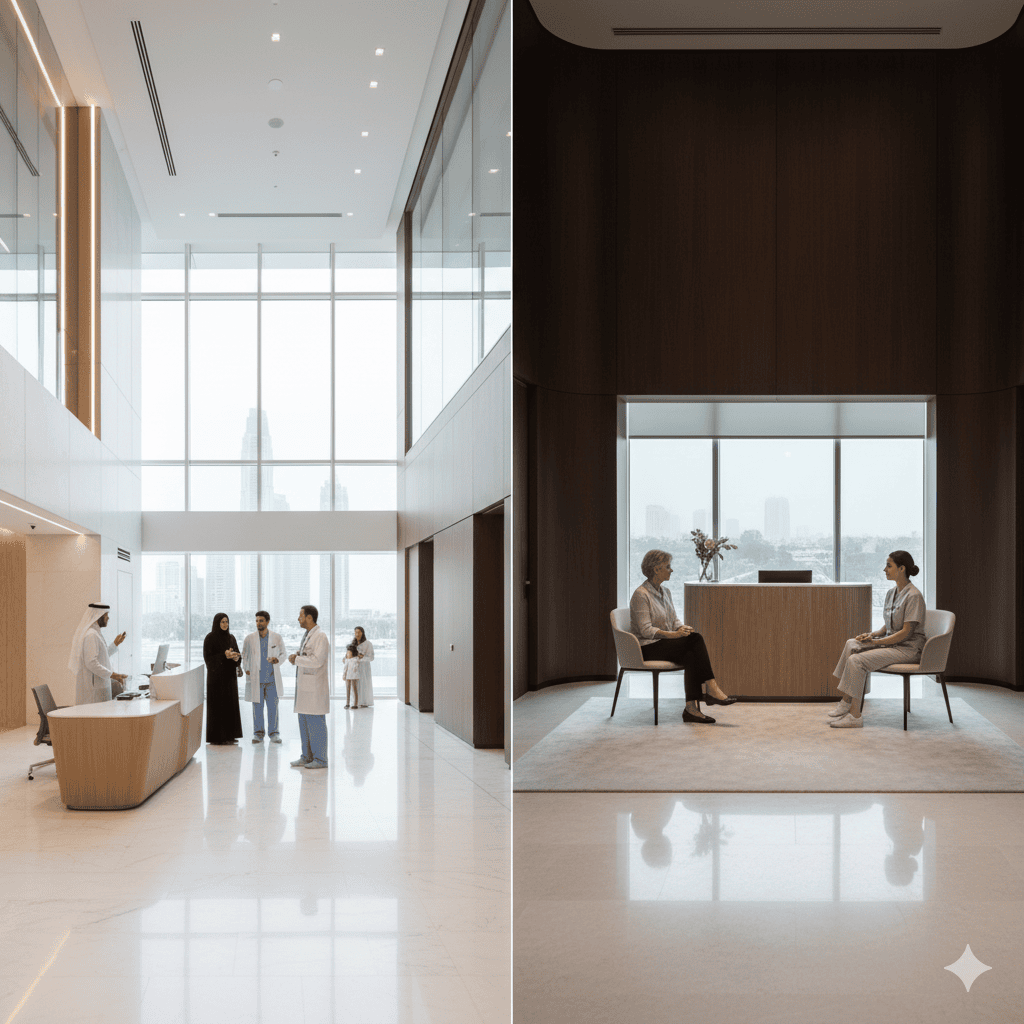
How scope, culture and progression differ between Gulf providers for Western-trained doctors, nurses and physiotherapists
When Western-trained doctors, nurses and physiotherapists decide to move to the Gulf, they often see “private sector” as a single category. On the ground in Dubai, Abu Dhabi, Riyadh and Doha, the reality is more nuanced. Private hospitals and private clinics can feel like two different worlds—both attractive, both demanding, but with very different rhythms, cultures and career trajectories for Western-trained clinicians.
Private hospitals in the Gulf tend to be larger ecosystems. Western-trained teams work in multidisciplinary departments with ICU, theatres, diagnostics and emergency services under one roof. For doctors, this can mean broader scope, complex cases and closer alignment with DHA, DOH, SCFHS or QCHP governance frameworks. For nurses and physiotherapists, it can mean structured pathways, formal rotas, teaching opportunities and exposure to UHNWI patients through VIP wards or linked royal household arrangements.
Private clinics, by contrast, are more focused. A Western-trained clinician in a Dubai clinic might run high-intensity outpatient lists, shorter episodes of care and streamlined care pathways. Physiotherapists often see motivated, self-referring patients; nurses support procedure rooms and follow-up rather than full inpatient stays. For many Western-trained clinicians, clinics offer tighter teams, lighter night commitments and clearer working hours—but sometimes fewer internal progression layers.
Culture often feels different too. In Gulf private hospitals, culture is shaped by layers of leadership, multiple specialties and a visible governance structure. That can bring stability and learning—or bureaucracy and slower change. In private clinics, culture is close to the founders: a small group of decision-makers sets tone on patient experience, escalation, rota flexibility and how Western-trained voices are heard. This can be energising when values align, and frustrating when they do not.
UHNWI and royal household exposure also shifts across settings. High-end private hospitals in Abu Dhabi or Riyadh may host VIP floors, concierge pathways and formal agreements with UHNW families. Western-trained clinicians here balance everyday patients with complex, discreet cases. In boutique clinics and concierge setups, the overlap with UHNW life can be more direct: private physicians, nurses and physiotherapists may see the same family across multiple locations, often coordinating closely with hospital teams for admissions and investigations.
Career progression is not only about titles, but structure helps. In a large Gulf private hospital, Western-trained clinicians can move from service-level roles into education, governance, department leadership and eventually regional responsibilities. Clinics may offer faster influence on service design, branding and patient experience, but fewer rungs on the formal ladder. The choice depends on whether you see yourself as a future head of department, a clinical lead in a small high-end team, or a long-term UHNWI-focused clinician.
Workload pattern is another deciding factor. Hospital roles often involve nights, weekends and exposure to emergencies, which can be professionally satisfying but physically demanding. Clinics typically offer more regular hours, though some extend into evenings and Saturdays to match Gulf patient demand. For Western-trained clinicians bringing families to the United Arab Emirates or Saudi Arabia, matching rota patterns to family life, schooling and recovery time becomes as important as the base salary.
For employers, recognising these differences is key to retention. A complex-care Western-trained intensivist may belong in a flagship hospital in Dubai; a rehabilitation specialist physiotherapist may thrive in a focused clinic in Doha; a private nurse with strong home-care skills may be best placed in roles that bridge clinics, hospitals and UHNW households. Misalignment between clinician profile and setting leads to early exits, even if the package looks generous on paper.
At Medical Staff Talent, we specialise in this matching process. We recruit Western-trained Doctors, Nurses and Physiotherapists into private hospitals, private clinics, medical concierge services, royal households and UHNW families across Dubai, Abu Dhabi, Riyadh and Doha. When we speak to candidates, we do not just ask “hospital or clinic?”—we ask how they like to work, learn, lead and live. When we speak to providers, we ask which kind of Western-trained clinician actually thrives in their environment, not just who fits a job description.
The question for any Western-trained clinician is simple: “Which Gulf environment will let me practise at my level, protect my wellbeing and give me a realistic path over the next five years?” For providers, the mirror is: “Are we a hospital, clinic or hybrid—and do we understand what that really means for Western-trained talent?” At Medical Staff Talent, we do not place staff into generic “private sector” boxes. We help build stable, trusted medical teams in the Gulf by aligning the right clinicians with the right type of provider from the very beginning.