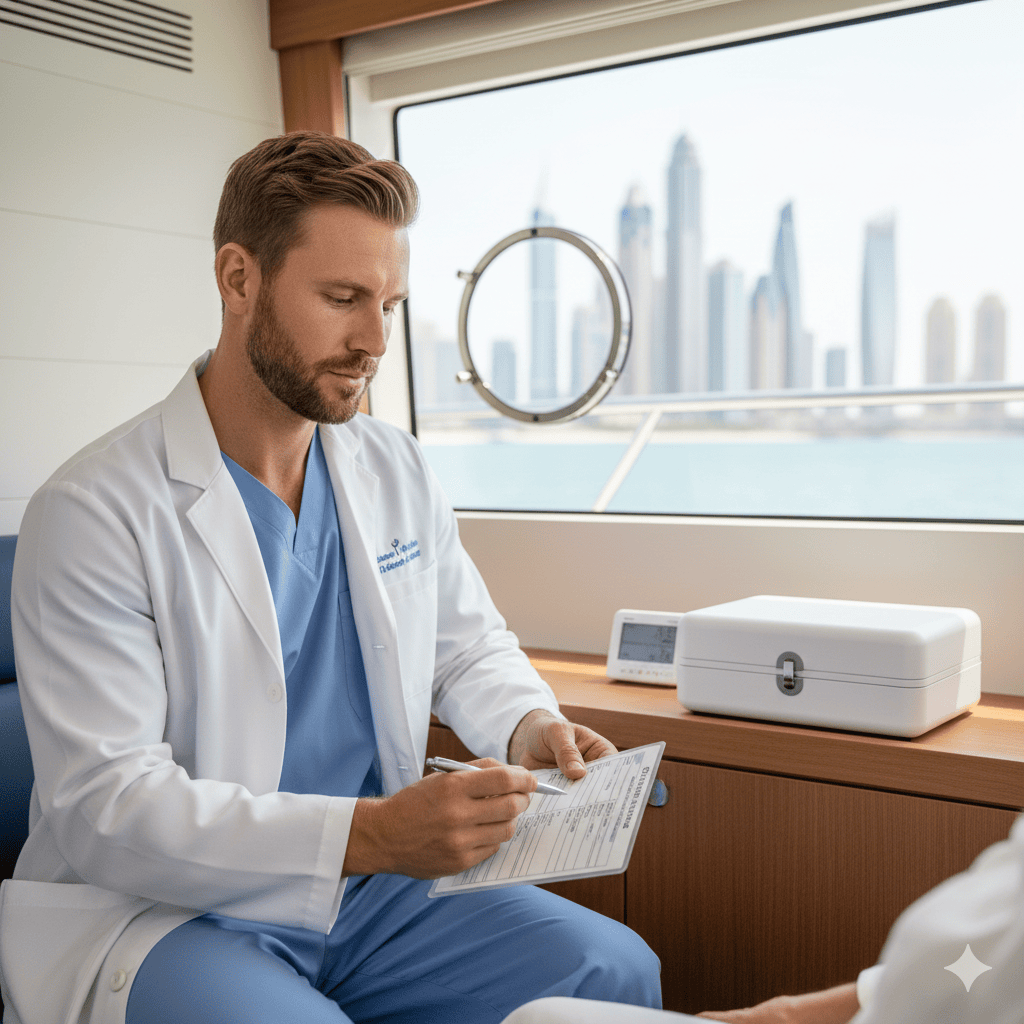
Why concierge/yacht care is not “hospital at home”
Premium households expect quiet reliability, but governance must equal hospital standards. Three documents protect practice: licence/privileges naming domiciliary settings, malpractice schedule listing home/hotel/yacht, and a short SOP that staff actually use. Without those, risk shifts to the clinician.
Scope & governance (draw the line first)
Licence & privileges: add domiciliary to the privilege list; specify procedures you are authorised to perform outside hospital.
Insurance: occurrence vs claims-made; name home/hotel/yacht explicitly; confirm tail if claims-made.
Medical lead: one consultant of record; all changes to plan flow through this lead.
Consent & privacy: written consent; neutral language in semi-public areas; no clinical content on personal apps.
Medication custody & devices (copy/paste controls)
Locked storage; temperature log for cold-chain items.
Two-person check for high-risk meds (insulin, anticoagulants, opioids, electrolytes).
No decanting/relabelling; pharmacy packaging only.
Devices: IFU available; cleaning/maintenance schedule; disposables stock with batch/expiry tracked.
Staffing & rota (stability over heroics)
Pair high-risk sessions (sedation support, chemo interfaces, complex dressings) with a second clinician.
MAX 3 consecutive nights; post-call rest protected.
Weekly micro-brief (15 min): incidents, near-misses, one change adopted.
Documentation that travels
Domiciliary note with time, assessment, actions, and numeric escalation thresholds.
MAR or medication chart where applicable; waste log for controlled drugs.
Handover to medical lead via approved channel; SBAR with “R” = next steps + who to call.
Escalation & transfer (calm choreography)
Pre-agreed receiving hospital and contact path.
Numeric triggers (e.g., SpO₂ <92% for 5 min, MAP <65, uncontrolled pain, active bleeding).
Prepare a transfer pack: SBAR summary, last vitals, MAR copy, devices/lines list.
Household PA/security handle logistics only, not clinical decisions.
Yacht-specific additions
Stabilise → transfer mindset; marina/helipad routes pre-planned.
Equipment secured against motion; cold-chain monitored; comms (VHF/phone) tested before departure.
Location handover includes GPS/berth plus nearest receiving facility.
Mini-audits (weekly, 5 items)
Cold-chain logs complete; excursions documented.
High-risk med double-checks recorded.
Last two visits include a numeric escalation line.
Device cleaning records up to date.
Privileges/insurance certificates current and visible in the pack.
Red flags—and fixes
Domiciliary work requested but no rider on insurance → add rider before visit.
Household pushes beyond scope → restate boundaries; escalate to medical lead.
Lack of safe storage → defer administration; document reason; re-schedule.
Solo clinician on high-risk session → re-staff; do not proceed.
Ready checklists
Arrival (home/hotel/yacht)
Consent confirmed; allergies reviewed; emergency address/coordinates ready
Equipment check; meds counted; waste containers present
Vital signs baseline; red-flag screen done
Before exit
MAR updated; waste counted/signed
SBAR to medical lead sent; next visit agreed
Environment left secure; log filed
Short FAQs
Please, talk to David on whatsapp: https://wa.me/34692100254