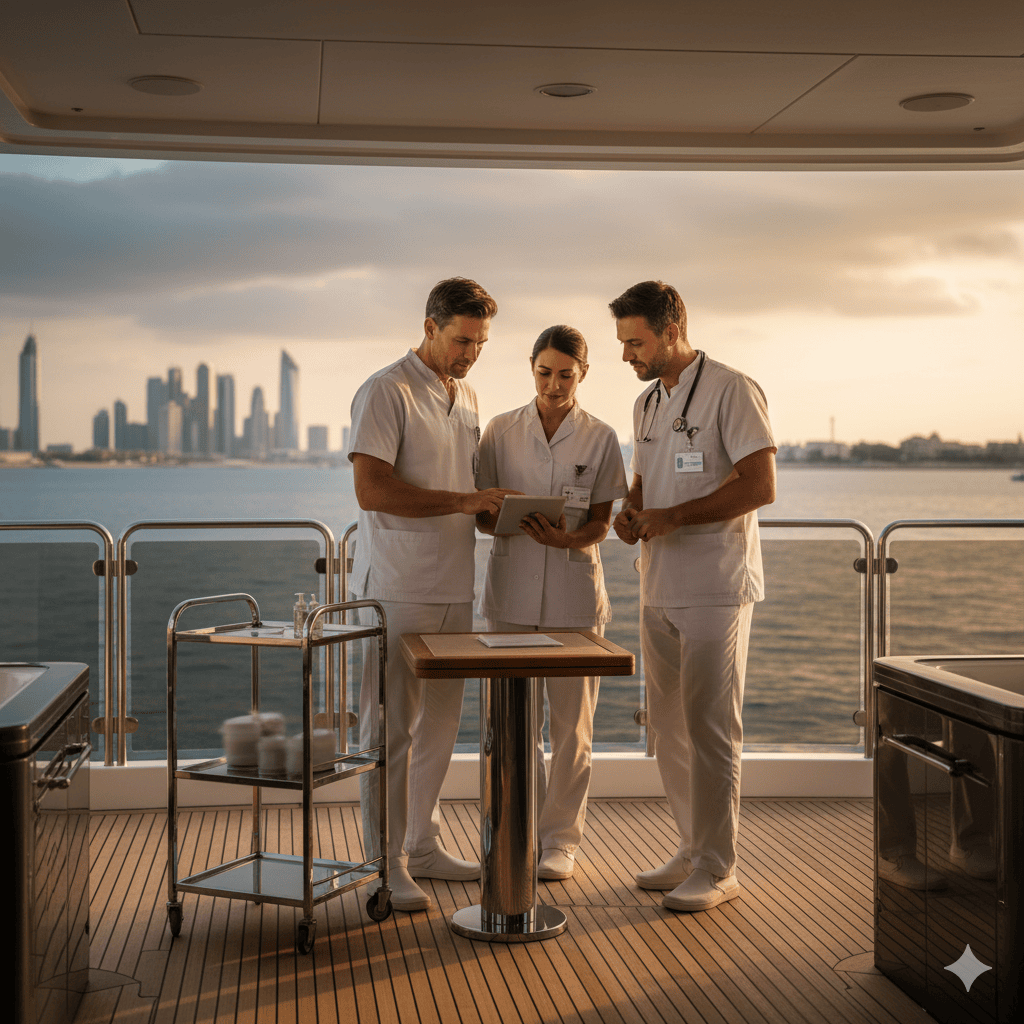
How doctors, nurses and physiotherapists can move calmly between sea, villa and private hospital in Dubai, Abu Dhabi, Riyadh and Doha
For many Western-trained clinicians, the most striking images of Gulf medicine are not wards or outpatient clinics—they are marina views and private villas. Yacht care outside Dubai, concierge medicine in Abu Dhabi, royal compounds near Riyadh and discreet home-care programmes in Doha have become part of the private health ecosystem. For Western-trained doctors, nurses and physiotherapists, these roles are not just glamorous extras; they are complex clinical environments that must stay tied to serious private hospitals and clinics in the Gulf.
The first reality is simple: there is no such thing as “standalone” yacht or concierge medicine. Western-trained clinicians caring for UHNW families on a yacht off Dubai, in a villa in Abu Dhabi or a compound near Riyadh are still practising under the shadow of DHA, DOH, SCFHS or QCHP standards. When something goes wrong, regulators and insurers will look for one thing: the care pathway between that private setting and a licensed private hospital or clinic in Dubai, Abu Dhabi, Riyadh or Doha. If that pathway exists only in people’s heads, your licence is carrying more risk than it should.
Safe concierge and yacht care starts with geography and affiliation. Western-trained doctors, nurses and physiotherapists should know exactly which private hospitals they are clinically anchored to, and how quickly they can reach them from yacht, villa or hotel. A cardiology event on a yacht near Dubai Marina, a neurological change in a Doha villa or sepsis in a Riyadh compound all require different logistics—but the same principle: a pre-agreed route into a named emergency department, critical care unit or specialist service, not a last-minute scramble through personal contacts.
Escalation in these settings is both clinical and social. UHNW families and royal households are used to control: they expect to choose when, where and how care escalates. Western-trained clinicians are used to thresholds: vital signs, risk scores and clear criteria for transfer. Stable concierge and yacht programmes in the Gulf are built where those two realities meet. That means written escalation triggers agreed between clinicians, families and partner hospitals, supported by SBAR-style handover templates that work across sea, villa and private hospital. Without that, escalation becomes a negotiation at exactly the wrong time.
Scope of practice is often challenged most at the bedside of an UHNW principal. A private nurse on a yacht off Dubai may be asked to manage procedures that belong in a high-dependency unit; a physiotherapist in an Abu Dhabi penthouse might be asked for opinions that really belong to a consultant; a doctor in a Doha villa might be pushed to delay transfer “until after tonight’s event”. Western-trained clinicians must know what their scope is under local licensing, and what lines they will not cross—even when the request comes with charm, pressure and the promise of discretion.
Documentation in concierge and yacht care feels awkward but is essential. Families often prefer minimal visible paperwork; Western-trained clinicians know that without records, there is no continuity, no handover and no defence if care is later questioned. The solution is not to abandon documentation but to design it carefully: secure electronic notes linked to partner private hospitals, brief but structured SBAR handovers, and clear logs of medications, observations and calls made. When cases move from villa or yacht to private hospital in Dubai, Abu Dhabi, Riyadh or Doha, that record is what allows seamless care instead of starting from scratch in the emergency department.
Team design matters as much as individual excellence. A single Western-trained doctor on call “for everything”, or a lone nurse living with a family in Abu Dhabi, is not a care system; it is a high-risk single point of failure. Sustainable concierge and yacht models in the Gulf pair Western-trained doctors, nurses and physiotherapists with clear cross-cover, protected rest and direct lines into hospital-based colleagues. Where those links are thin, clinicians quickly slide into permanent availability, quiet fatigue and higher error risk—especially when yacht movements, travel and late-night events are frequent.
Boundaries around time are particularly fragile in UHNW care. A Western-trained physiotherapist who begins with scheduled rehab sessions in Doha may find WhatsApp requests expanding into weekends; a nurse on a Riyadh estate may see her nominal days off slowly filled with “just one quick check”; a doctor attached to a Dubai family may discover that every international trip now comes with an expectation that they will attend. Good concierge programmes write availability, on-call windows and travel expectations into contracts and rotas, with explicit cover arrangements. Bad ones test how far each Western-trained clinician can stretch before they start saying no.
From the UHNW family perspective, linking yacht and concierge medicine to strong private hospitals and clinics is also self-protection. A well-equipped yacht with an excellent Western-trained nurse is still not an ICU. A palace clinic in Riyadh with premium equipment is still not a full tertiary hospital. Gulf families who understand this choose providers that can move calmly between environments: early detection at home or sea, decisive transfer to private hospitals in Dubai, Abu Dhabi, Riyadh or Doha when needed, and then step-down back to villa once safe. That loop is what protects both prestige and outcomes.
For Western-trained clinicians, the interview for any concierge or yacht role in the Gulf should focus less on amenities and more on architecture. Useful questions include:
Which private hospitals or clinics are we clinically aligned with in Dubai, Abu Dhabi, Riyadh or Doha?
What are the written pathways from yacht or villa to those hospitals at 02:00?
How are rotas, nights and travel shared across the team?
How is documentation handled, and who can access it?
What happened in the last serious clinical event—and what changed afterwards?
Answers that are specific, calm and consistent usually signal a serious system. Answers that rely on phrases like “we have excellent contacts everywhere” or “nothing serious has ever happened” should make Western-trained doctors, nurses and physiotherapists pause.
From the provider side, medical concierge and yacht care in the Gulf must be run as extended arms of private hospitals and clinics, not as detached luxury services. This means aligning licensing and privileging with DHA, DOH, SCFHS and QCHP rules; training Western-trained staff in escalation, documentation and UHNW communication; and designing rotas that protect both patients and people. Programmes that do this quietly become trusted partners for royal households and UHNW families. Those that do not eventually struggle—with regulators, insurers, or a reputation among Western-trained clinicians that spreads fast.
Medical Staff Talent operates precisely in this intersection. We specialise in recruiting Western-trained Doctors, Nurses and Physiotherapists into private hospitals, private clinics, medical concierge services, royal households and yacht-based roles across Dubai, Abu Dhabi, Riyadh and Doha. When we assess concierge or yacht opportunities, we look past the surface: we ask how they plug into hospitals, how escalation works at sea and on land, how documentation is secured, how rotas are built, and how Western-trained clinicians are protected when difficult decisions must be made quickly.
Our focus is simple: Western-trained clinicians should be able to practise at a serious level whether they are in a ward, a clinic, a villa or a yacht. That requires more than beautiful settings; it requires pathways, governance and culture that connect those settings to the Gulf’s best private hospitals and clinics. When those pieces are in place, medical concierge and yacht care becomes what it should be: a sophisticated extension of stable systems, not a risky stage for individuals.
For Western-trained doctors, nurses and physiotherapists considering these roles, the key question is not “Is the yacht impressive?” or “Is the family well known?” It is: If something goes wrong at sea or in a villa at 03:00, do I know exactly where this patient is going, who will receive them, and how my decisions will be supported afterwards? If the answer is yes, you may have found a serious chapter. If the answer is “I’m not sure, but they seem very connected”, you are being asked to trust networks instead of architecture.
At Medical Staff Talent, we help Western-trained clinicians and Gulf providers choose architecture. We do not place people into roles where the main plan is hope. Instead, we build stable, trusted Western-trained teams around clear pathways between yacht, villa and private hospital—so that UHNW care in Dubai, Abu Dhabi, Riyadh and Doha can be both discreet and clinically sound.