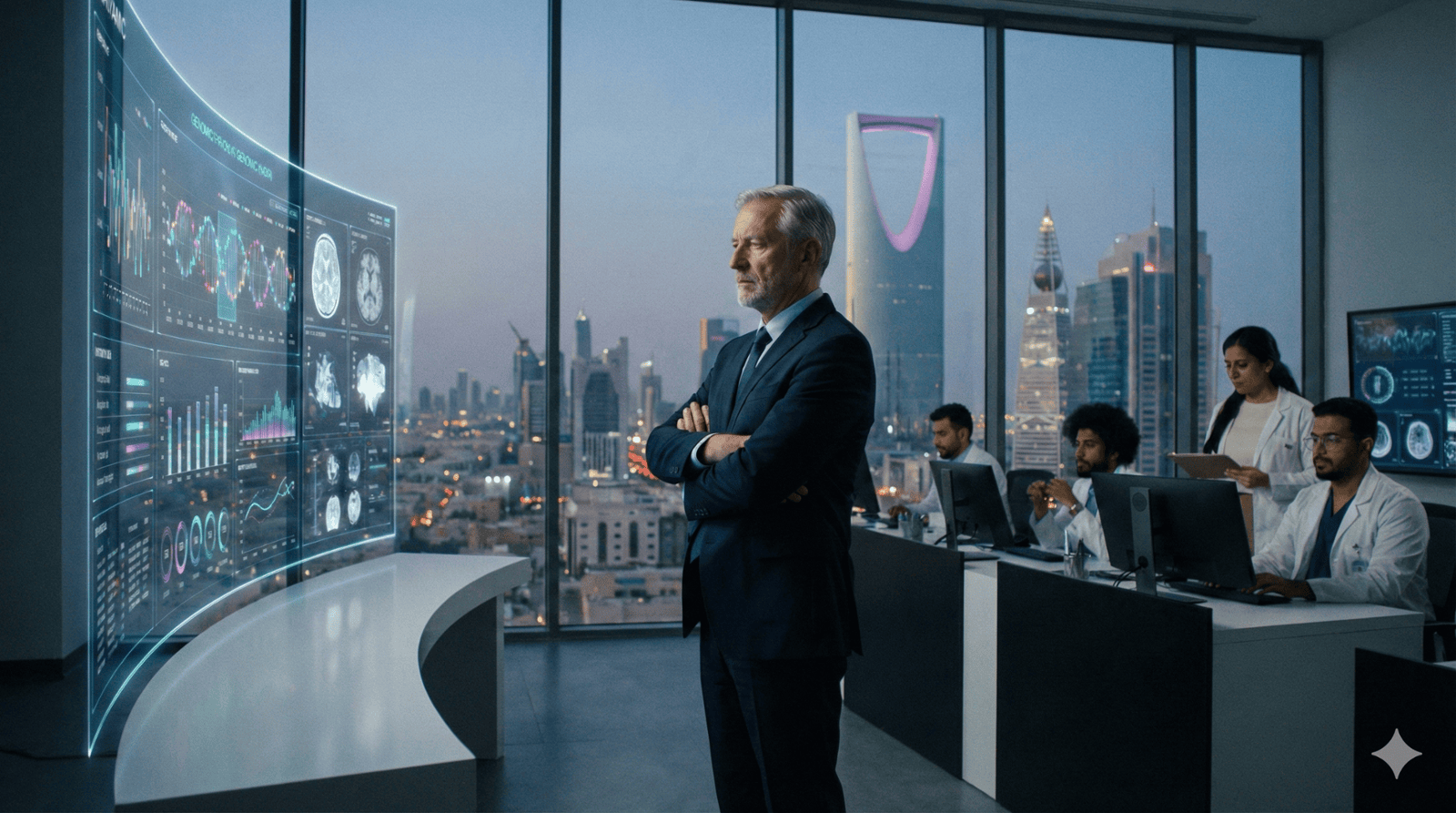
Beyond the equipment acquisition: Why CCT and Board Certified leadership is the prerequisite for successful AI and robotic integration in Dubai and Riyadh
The healthcare narrative in the Gulf Cooperation Council (GCC) is currently defined by unparalleled ambition. Driven by national agendas like Saudi Arabia’s Vision 2030 and the UAE’s Centenary 2071, the region is not merely attempting to catch up with global standards; it is aiming to leapfrog them. We are seeing staggering investments in genomic medicine, artificial intelligence diagnostic suites, and next-generation robotic surgery platforms.
However, for the investors and CEOs of Tier 1 JCI-accredited institutions and giga-projects, a critical realization is dawning: technology is not a strategy. Buying the world’s most advanced MRI scanner or Da Vinci robot does not guarantee world-class outcomes. The bottleneck to achieving the region’s futuristic healthcare vision is not capital or technology; it is elite clinical leadership capable of governing innovation safely.
The Gap Between Acquisition and Integration
In many emerging healthcare markets, there is a tendency to conflate the acquisition of hardware with clinical progress. It is relatively easy to procure cutting-edge equipment. It is exponentially harder to integrate that equipment into a safe, effective clinical workflow.
Without a rigorous framework of clinical governance, advanced technology can become a liability rather than an asset. It can lead to over-utilization, increased costs without improved outcomes, or, in the worst-case scenario, patient harm due to a lack of specialized training and oversight. This is the specific capability gap that elite Western-trained physician executives fill.
The Governance of Innovation
Leaders holding UK Certificate of Completion of Training (CCT), US Board Certification, or equivalent European credentials come from healthcare ecosystems that are inherently cautious about adopting new technologies without robust evidence. They are trained in systems dominated by Health Technology Assessment (HTA) bodies, ethical review boards, and rigorous peer review.
When a Western-trained Medical Director or Chief of Surgery is recruited into a Gulf institution, they bring this ingrained discipline with them. They do not just deploy new technology; they build the governance structure around it. They establish the credentialing protocols for staff who will use the equipment, they set up the audit trails to monitor outcomes, and they ensure that the adoption of AI or robotics is driven by patient need, not just marketing hype.
Leading the High-Tech Workforce
Implementing innovations like genomic sequencing or AI-driven pathology requires leading highly specialized, often diverse teams. A Western-trained leader acts as the intellectual bridge. They have the scientific literacy to engage with data scientists and geneticists, while possessing the clinical authority to translate those insights into bedside protocols for physicians and nurses.
Furthermore, in competitive markets like Dubai and Riyadh, top-tier global talent—the specialized robotic surgeons or AI researchers—prefer to work under leadership whose credentials they recognize and respect. A CCT-qualified Chief Medical Officer acts as a talent magnet for the specialized workforce needed to run a futuristic facility.
Conclusion
For the Gulf to realize its ambition of becoming a global epicenter for future health, the investment in human capital must match the investment in technology. The most successful institutions over the next decade will be those that recognize that innovation requires governance. Securing Western-trained leaders who balance clinical rigor with a forward-looking mindset is the only way to future-proof healthcare investments in the region.
Contact David for a confidential discussion on securing your next elite hire or role.