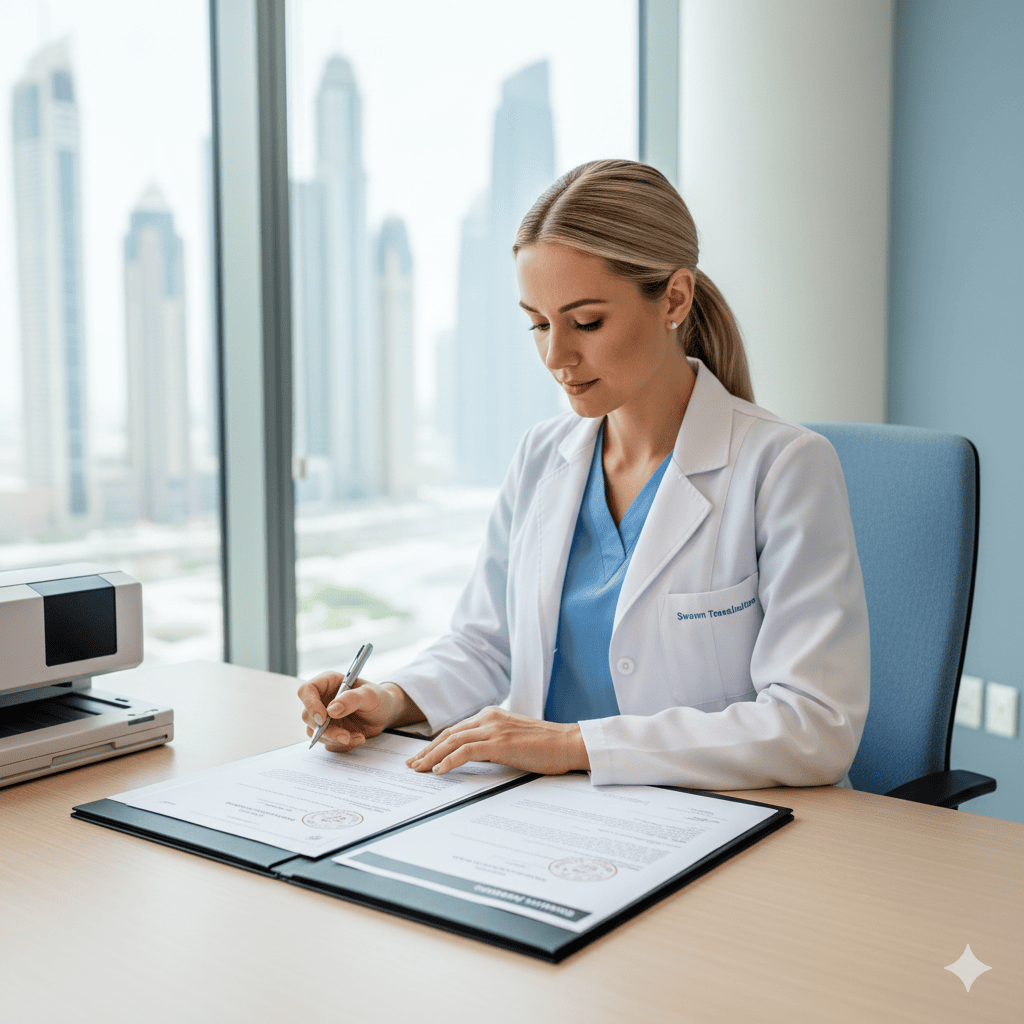
Why the order matters (and saves weeks)
Licensing, DataFlow/PSV and visas fail when the sequence is wrong. Regulators want original → legalisation → sworn translation in that order, merged into one colour PDF. Do it once, do it cleanly, and every downstream step (credentialing, visas, family sponsorship) goes quieter.
What usually needs legalising (signals, not promises)
Education: degree + transcript.
Professional: licence/registration, Good Standing/CCPS.
Civil: marriage and birth certificates (for dependants).
- Security:police clearance (if requested).Always check the live requirement; if in doubt, legalise the highest-risk blockers first (education, civil, security).
Hague vs consular: choose your lane
Hague signatory (Apostille): your home authority issues an Apostille confirming the document’s origin. Many Western countries use this route.
- Non-Hague or destination-specific request: do consular legalisation—typically foreign ministry authentication → destination embassy/consulate.Destination rules and portal steps can evolve; follow your home authority’s guidance and the destination regulator/embassy page for the final hop.
The clean sequence (copy/paste)
Get the original document in your passport-exact name (all middle names).
Legalise
Hague route → Apostille on the original or a certified copy.
Consular route → foreign ministry authentication → UAE/KSA/Qatar embassy.
Sworn translation (English/Arabic) after legalisation, with translator credentials shown.
Build one colour PDF (300–400 dpi): Original → Legalisation → Translation.
Filename:
Surname_Name_[DocType]_[IssuerCountry]_YYYYMM.pdf.Upload to the correct bucket (DataFlow: Education/Licence/Employment/Good Standing; regulator/visa portal per step).
Country quick map (plain English examples)
UK/IE/EU (Hague): Apostille via FCDO/foreign affairs; sworn translation after.
US/Canada (Hague): State/provincial steps may precede Apostille; confirm exact path; then translation.
Australia/New Zealand (Hague): Department of Foreign Affairs/External Affairs Apostille; then translation.
If your document is from a non-Hague country: authenticate at the foreign ministry → legalise at UAE/KSA/Qatar embassy → then translation.
Evidence hygiene that moves files fast
Colour scans only; all seals/stamps fully visible at 100% zoom.
No mixed PDFs (don’t put marriage + degree together).
Use the same email/phone and passport-exact name across every portal.
Keep a one-page index listing each document, issuer, and issue date.
Common pitfalls—and calm fixes
Translated before legalised → redo translation after legalisation.
Name mismatch (maiden/abbreviated) → add a linking document (marriage/change-of-name) in the same PDF.
Low-resolution scans → rescan at 300–400 dpi; avoid shadows/cropping.
Wrong bucket → move to the right category and leave a short reviewer note.
Expired police/Good Standing → reorder within the regulator’s recency window; diary refresh dates now.
Copy-paste checklists
Pre-legalisation
Passport-exact name confirmed on all source documents
Hague vs consular route identified
Translator shortlisted (post-legalisation)
Assembly day
Legalised originals received
Sworn translations completed and stamped
One colour PDF per item built; filenames clean
Quick self-audit at 100% zoom (seals/stamps readable)
Upload & tracking
Correct portal bucket selected
Receipt/acknowledgment saved
Follow-up date diarised (+7 days)
Backup set stored securely (cloud + local)